New Roofs in Royal Wootton Bassett
Local roofers for repairs, new roofs & flat roofing. Free surveys, fixed written quotes, tidy workmanship.
A large share of Royal Wootton Bassett was built between the late 1960s and the mid 1980s, as the town grew outward from the old High Street towards Whitehill and Templars Firs. Those estates were covered almost universally in concrete interlocking tiles, and concrete interlockers have a service life of roughly fifty to sixty years. The town has arrived at that point more or less all at once.
That is why so many SN4 households are getting the same news from the same generation of roof: not one dramatic failure, but nail fatigue, porous tiles and a felt underlay that has gone brittle enough to tear when anyone walks the loft.
How to tell a re-roof from a repair
A repair fixes an event. A re-roof answers a pattern. The honest dividing line is whether the same roof keeps producing new problems in new places — three slipped tiles in three different areas over two winters is not bad luck, it is nail fatigue announcing itself, and patching it individually costs more over five years than replacing it once.
The second test is the underlay. On roofs of this age the felt beneath the tiles has usually gone the colour and texture of a digestive biscuit. Once it tears, every gust drives rain straight onto the ceiling below regardless of how good the tiles above it look from the road. You cannot replace underlay without stripping the covering, which is what turns a repair conversation into a re-roof one.
Nail fatigue
Original steel nails corrode from the shank outwards. Tiles slip in ones and twos, from no particular part of the roof, over successive winters.
Porous concrete
Concrete interlockers absorb water as they age, growing heavier and frost-prone. A tile that crumbles at the edge when handled is past arguing about.
Perished underlay
Bitumen felt from the 1970s tears under its own weight. Visible from inside the loft on a bright day as pinholes of daylight along the rafter lines.
Sagging battens
Ungraded softwood battens rot where the underlay has leaked. A roof line that dips between rafters is telling you the timber has gone.
What a full re-roof involves
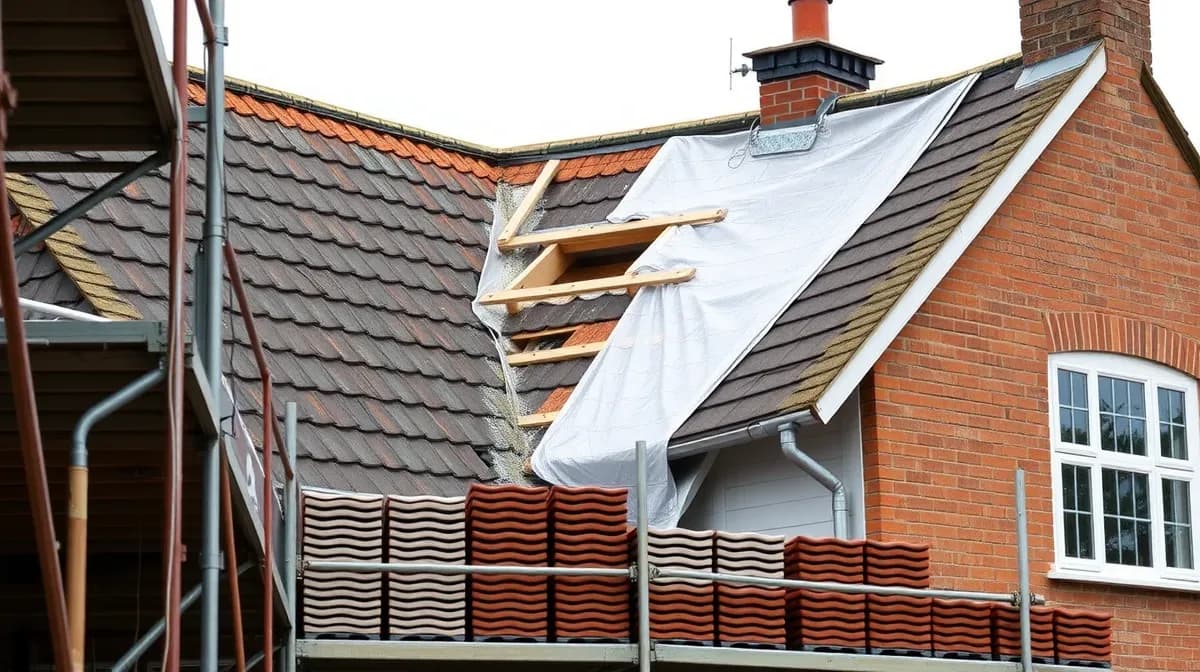
Scaffold first, always — for a two-storey property in Royal Wootton Bassett that means an edge-protected working platform, not a ladder and optimism. The old covering comes off to the rafters and goes into a skip, and only at that point can anyone see the deck honestly. Soft or rotten battens are replaced rather than reused; on the older High Street properties this is routine rather than exceptional.
Then a breathable membrane, counter-battened where the pitch or the exposure calls for it, new graded battens set to the correct gauge for the tile, and the covering itself. Ridge and verge are mechanically fixed — dry-fixed systems using clips and screws rather than the sand-and-cement mortar bedding that used to be standard. That is not a preference; since the 2014 revision of BS 5534, mortar alone is no longer an acceptable fixing for ridge, hip and verge on a new roof.
Finally the roofline: gutters, fascias and soffits are almost always renewed at the same time, because the scaffold is already up and doing it separately later costs more than doing it now.
New roof prices in Royal Wootton Bassett
| Property | Typical full re-roof |
|---|---|
| Terraced house, concrete interlocking | £5,200 – £7,500 |
| Semi-detached, concrete interlocking | £6,800 – £9,500 |
| Detached, plain tile or slate | £11,000 – £18,000 |
| Bungalow, single storey | £4,800 – £7,000 |
| Garage or outbuilding, pitched | £1,900 – £3,400 |
Includes scaffold, strip and disposal, new breathable membrane, graded battens, dry ridge and verge, and covering. Chimney work, structural timber repairs and roofline replacement are itemised separately rather than buried in a single figure.
Matching a roof in a conservation area
The older core of the town — the High Street, the ground around the seventeenth-century Town Hall on its stone pillars, and the lanes running off it — sits within a conservation area, and roofs there are not a free choice. Handmade clay plain tiles, natural slate and stone are the local vocabulary, and replacing any of them with a modern concrete interlocker is the kind of decision that attracts correspondence from the planning department.
The practical answer is usually reclaimed or hand-made-to-match rather than nearest-modern-equivalent, and it costs more. It is worth knowing that before you compare two quotes that look wildly different, because one of them may have quoted the right tile and the other the cheap one.
Roof replacement, explained
The full process, timings and what changes at each stage.
What a new roof costs
2026 price guide with the variables that actually move the number.
Frequently asked questions
Ready for a free, no-obligation quote?
Call 01793 569397