Slate & Tile Roofing in Royal Wootton Bassett
Local roofers for repairs, new roofs & flat roofing. Free surveys, fixed written quotes, tidy workmanship.
Pitched roofs in SN4 come in three distinct generations, and they fail in three distinct ways. The oldest properties around the market square carry handmade clay plain tiles or natural slate on riven battens. The interwar and post-war housing carries early concrete tiles. The estates built since the 1990s out towards Ballards Ash and Coped Hall carry modern interlockers on graded battens and a plastic-based underlay.
Knowing which one you are standing under decides everything about what happens next — what can be repaired, what has to be replaced, and what it is legal to fix it with.

Natural slate
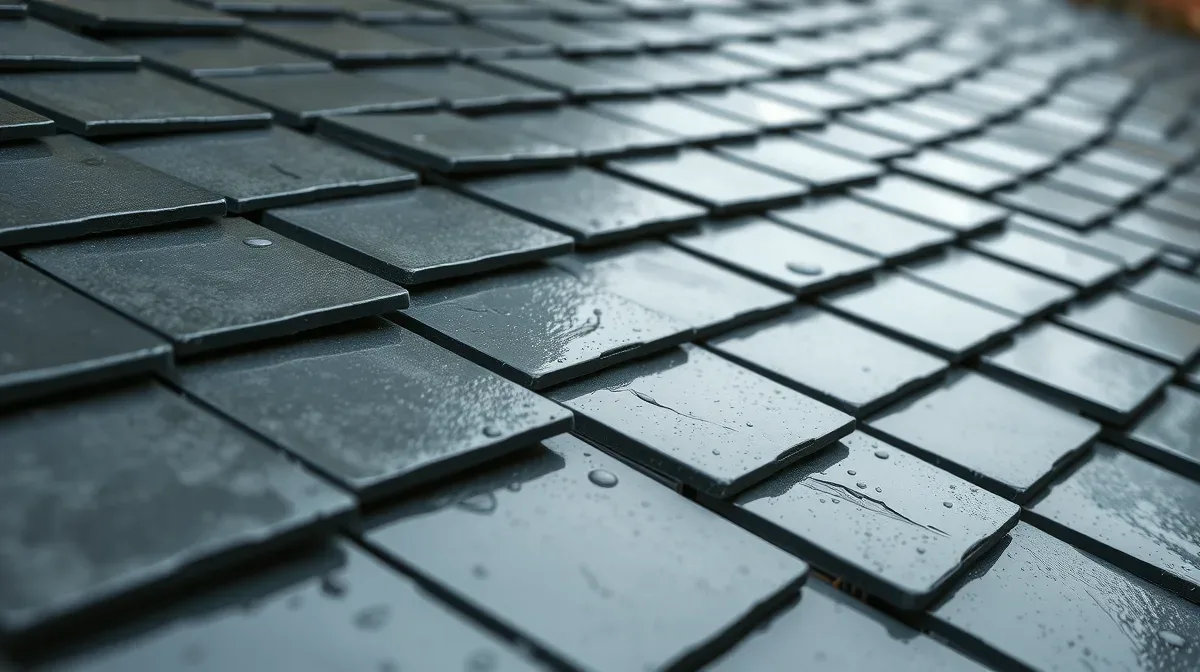
Slate is a hundred-year material hung on fixings that rarely last half that. When a Welsh slate roof starts shedding, the slate is almost never the problem — the nails have corroded and the slate has simply let go. That is why slate roofs tend to fail gradually and then all at once, and why a roof shedding one slate a month is a roof approaching a decision.
Individual slates are re-hung with a copper or stainless tingle, a thin strip bent over the slate's lower edge to hold it. Done properly it is invisible from the ground and lasts. Done with lead offcuts and enthusiasm it drops the slate again within two winters. On a roof where tingles are already visible in numbers, patching further is throwing money at a roof that has told you what it needs.
Clay plain tile
The small handmade clay tiles on the older High Street properties are double-lapped, nib-hung and often four hundred to the square metre. They weather beautifully and they are unforgiving of poor matching — a modern machine-made clay tile set into a hand-made roof reads as a patch from across the street, because the colour is uniform and the camber is regular where the originals are neither.
Sourcing is the real work on these roofs. Reclaimed tiles of the right size and period, or a hand-made equivalent from a specialist producer, cost more and take longer to arrive than anything off a merchant's shelf. Where a roof needs a significant area replacing, the usual answer is to rob sound original tiles from a hidden elevation to make the visible face perfect, and put the new tiles round the back where nobody stands.
Concrete interlocking tiles
The workhorse covering of the town's post-war expansion. Interlockers are large, quick to lay and cheap per square metre, and they are the reason so many roofs here look sound from the pavement while the underlay beneath them has gone. They also absorb water as they age, and a saturated concrete tile weighs meaningfully more than a dry one — a factor on roofs whose structure was designed to the minimum of its day.
Individual replacement is straightforward while the range is still made. Once a pattern is discontinued, and many 1970s profiles are, matching becomes a salvage exercise and the argument for re-covering the whole slope strengthens considerably.
Slipped and cracked tiles
Re-bedded or re-hung individually where the surrounding covering has life left in it.
Ridge and hip
Re-fixed with dry systems — clips and screws — rather than re-bedded in mortar that will crack again.
Valleys
Lead or GRP valley linings replaced where the original has split, which is where most persistent leaks on complex roofs originate.
Verge
Dry verge units replacing crumbling mortar bedding at the gable ends, the most exposed detail on the roof.
Why mortar is no longer enough
Anyone quoting to re-bed your ridge tiles in sand and cement alone on a new roof is quoting for work that no longer meets the standard. The 2014 revision of BS 5534 removed mortar as a sole fixing for ridge, hip and verge, and required mechanical fixing — clips, screws, or dry-fix systems that hold the tile whatever the mortar does.
The reasoning is exposure, and Royal Wootton Bassett has plenty of it. The town sits high on the Wiltshire clay vale with very little between it and the prevailing south-westerlies, and the newer estates on the western edge take the full force of it. Mortar shrinks and splits; rain finds the split; a hard frost levers it wider still, and one January a ridge tile leaves the roof entirely. A mechanically fixed ridge does not care what the mortar is doing.
Slate and tile prices
| Work | Typical price |
|---|---|
| Replace slipped tiles (up to 10) | £180 – £340 |
| Re-hang slipped slates with tingles | £220 – £420 |
| Re-bed and mechanically fix ridge, per metre | £45 – £70 |
| Dry verge system, per gable | £280 – £480 |
| Replace lead valley lining | £600 – £1,400 |
| Re-slate a roof slope, natural Welsh slate | £9,000 – £16,000 |
Access dictates a great deal of this. Anything reachable from a scaffold tower prices very differently from work needing a full scaffold or a roof edge protection system.
Frequently asked questions
Ready for a free, no-obligation quote?
Call 01793 569397